Space tourism and climate justice
Estimates and perspective on carbon footprints per passenger for typical space tourism flights.
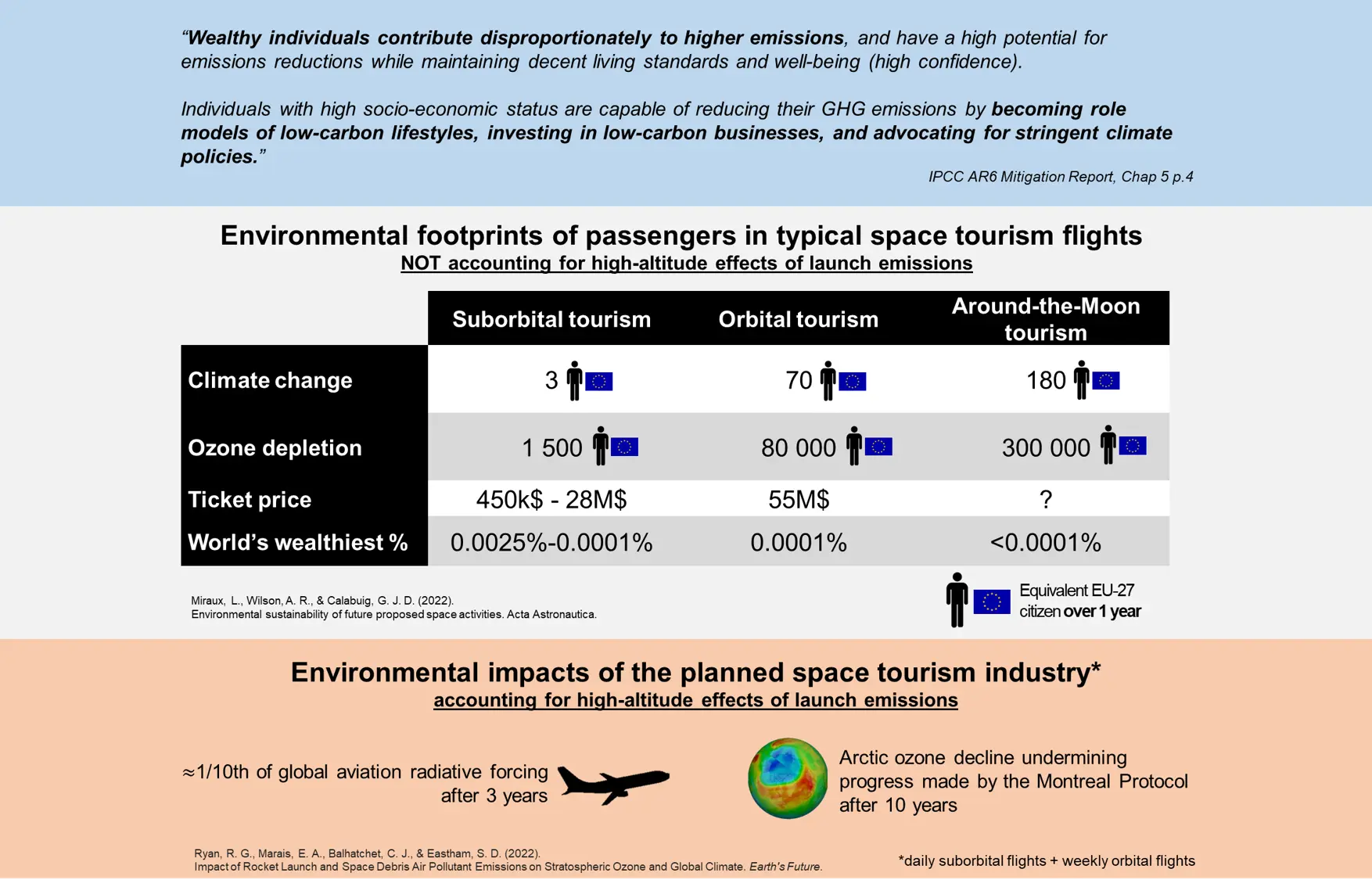
In their latest report, the IPCC emphasized the importance of climate justice and inequality, calling the wealthiest to become “role models of low-carbon lifestyles”.
Wealthy individuals contribute disproportionately to higher emissions, and have a high potential for emissions reductions while maintaining decent living standards and well-being (high confidence).
Individuals with high socio-economic status are capable of reducing their GHG emissions by becoming role models of low-carbon lifestyles, investing in low-carbon businesses, and advocating for stringent climate policies.
— IPCC AR6 Mitigation Report, Chap 5 p.4
Meanwhile, in the space sector, billionaires are making space tourism become a reality. The first commercial flights took place last year, both sub-orbital (J. Bezos’ Blue Origin and R. Branson’s Virgin Galactic) and orbital (E. Musk’s SpaceX). Blue Origin made its 6th tourism flight last month. Virgin Galactic plans to fly again only in 2023, but reports having sold >700 seats and announced plans to make 400 flights per year, and hopes to democratize space “for all humanity”. SpaceX made two tourism flights (1 to orbit, 1 to the ISS), and is planning to continue to do that in addition to an around-the-moon tourism flight planned next year.
My latest research shows that these flights are characterized by an unparalleled combination of economic inaccessibility and high environmental footprints per passenger, making them most critical in terms of climate and environmental inequalities1.
Footprints were obtained by accounting for the production of launch systems + the production of the fuel/oxidizer and their combustion during launch. However, the impacts of launch emissions were highly simplified and don’t account for high-altitude effects such as the accumulation of particles like soots in the stratosphere, which can substantially worsen the results, as I have discussed in a former article. They are, therefore, only lower bounds:
- Suborbital flight: >30t CO2eq per passenger
- Earth orbit: >660
- Around the moon: >1500
- Average European in 1 year: 9.2 (world average: 4.5)
We are far from these “role models of low-carbon lifestyles”…
But the environmental impacts of space tourism are not just about climate change. Ozone depletion, which was evaluated using a best-available estimate approach, could be very large. Air acidification also shows such concerning levels of impacts, originating from fuel/oxidizer production.
However, besides the environmental justice/inequalities aspect, one might think that this doesn’t cause significant environmental damage globally because this industry is so small.
On the contrary, a recent study2 focused on the impacts of launch emissions accounting for high-altitude effects, and found that ozone depletion caused by a decade of emissions of announced space tourism flights would undermine the recovery achieved over the Arctic with the Montreal Protocol. Moreover, soots emissions would create a radiative forcing equivalent to ~1/10th of global aviation “after just 3 years of routine space tourism launches”.
Thus, in addition to being reserved for the world’s richest 0.0025% or even 0.0001%, space tourism is the most environmentally destructive existing activity they can choose, more than yachts or private jets. It urgently needs to be regulated.
A more extensive discussion on this topic is now available here
References
1. Miraux, L., Wilson, A. R., & Calabuig, G. J. D. (2022). Environmental sustainability of future proposed space activities. Acta Astronautica.
2. Ryan, R. G., Marais, E. A., Balhatchet, C. J., & Eastham, S. D. (2022). Impact of Rocket Launch and Space Debris Air Pollutant Emissions on Stratospheric Ozone and Global Climate. Earth’s Future.