The stratospheric impact of space tourism
Why CO2 is only the tip of the climate iceberg for suborbital flights from Virgin Galactic and Blue Origin.
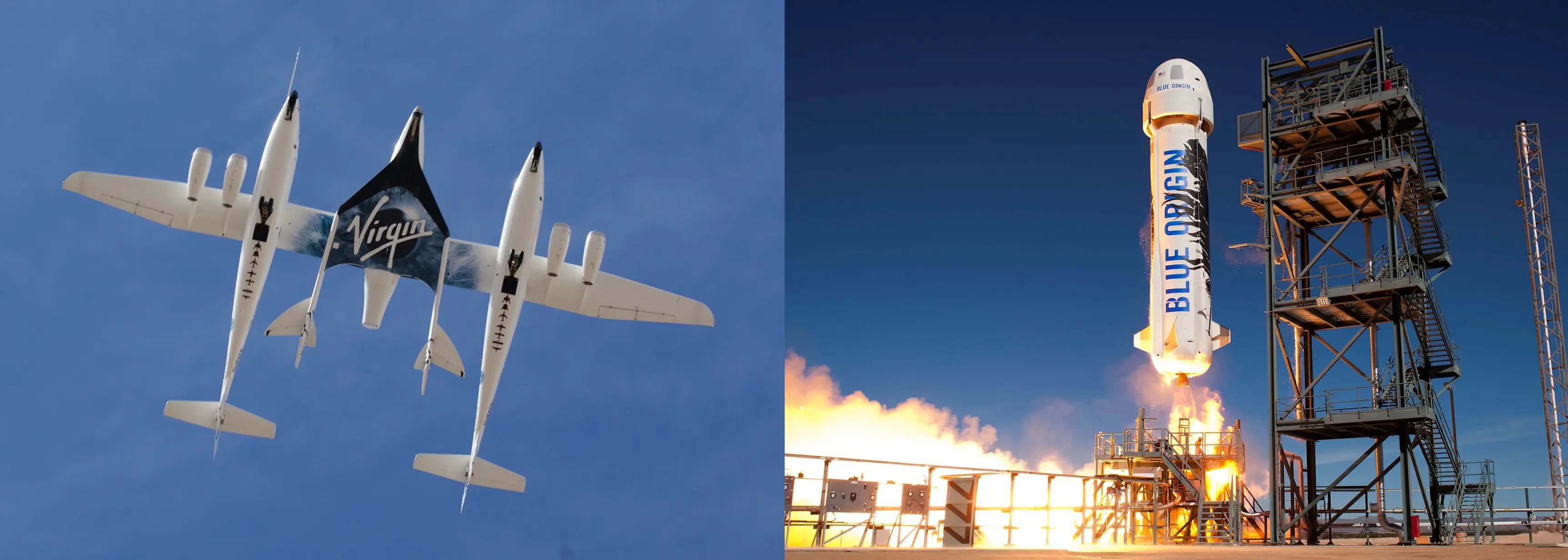
Source : Jeff Foust; Blue Origin
An already high CO2 record, yet largely secondary
In the press and on social media, several figures of a few dozen tons of CO2 per passenger were announced for the recent flights of Virgin Galactic (Richard Branson) and Blue Origin (Jeff Bezos).
Some have used these figures to rightly denounce the climate injustice of this tourism, which consists of ascending to high altitude to spend a few minutes in space before returning to Earth. However, these figures all share a common flaw: they only consider CO2, whereas its impact is completely negligible within the total climate impact of these flights.
Two technologies, two emission cocktails
The two space tourism companies use very different propulsion technologies. Virgin Galactic’s SpaceShipTwo, which carried Richard Branson, is powered by an engine using a hydrocarbon-based fuel (HTPB). Blue Origin’s New Shepard, which carried Jeff Bezos, is a “cryogenic” rocket because it operates on liquid oxygen and liquid hydrogen.
During operation, SpaceShipTwo emits CO2, but above all, an enormous quantity of soot particles (potentially up to 1000x more than a modern jet engine), particularly in the stratosphere where they remain for several years.
Stratospheric warming with uncertain consequences
These particles absorb sunlight, which warms the stratosphere (the layer located above the one in which we live, the troposphere)1.
However, the consequences for the troposphere are complex and still very poorly understood. It is well known in the context of solar geoengineering that injecting particles into the stratosphere has the effect of cooling the troposphere by preventing part of the sun’s rays from reaching it. The global effect of a fleet of SpaceShipTwo vehicles would therefore be an (uncontrolled) cooling of the troposphere. But partly because emissions from such a fleet would not be homogeneous around the globe—as the majority of launch bases are concentrated in the mid-latitudes of the Northern Hemisphere—the complex climate response could also result in local warming in certain regions1.
For example, a 2010 study2 modeled the climate impact of a fleet of 1,000 launches per year of typical space tourism vehicles (SpaceShipTwo type) over 10 years, corresponding to a plausible market development scenario for ~2030-2040. The result: a climate influence comparable (in terms of radiative forcing) to that of aviation, and a possible increase in surface temperature at the poles of up to +1°C. It appears that, due to its disproportionate impact, space tourism has the potential to be a problem beyond the pure symbolic aspect of climate injustice.
The climate effect of this soot, expressed by radiative forcing, is several orders of magnitude higher than that of CO2. In 2014, a study1 accounting for the soot effect estimated that a passenger on a typical space tourism flight (SpaceShipTwo type) had an “analogous” carbon footprint comparable to that of a passenger making thousands of round-trip flights between Los Angeles and London. This means several thousand tons of CO2, much more than the few dozen tons usually announced. This discrepancy exists because in its 2012 report describing the climate impact of SpaceShipTwo, the FAA (Federal Aviation Administration) only considered CO2 (likely due to a lack of knowledge and/or the complexity and low state of advancement of science regarding the impact of soot).
No, water vapor is not without climate effects
The New Shepard burns liquid oxygen and liquid hydrogen, which mainly produces water vapor. This has been highlighted many times to serve the argument that its flight phase has no impact on the climate because there is “no CO2.” This is totally false. In fact, the radiative forcing of water vapor emitted by a cryogenic rocket is several orders of magnitude greater than that of the CO2 emitted by a hydrocarbon-based rocket. On the other hand, a hydrocarbon-based rocket will emit soot, and thus will ultimately be much “dirtier” than a cryogenic rocket, but CO2 plays only an insignificant role in the comparison.
The climate impact of New Shepard is therefore much lower than that of SpaceShipTwo because of the latter’s soot, but this impact remains no less scandalous given the purpose of these flights.
Ozone depletion
Finally, all rocket fuels destroy stratospheric ozone. Even if the two vehicles in question are not the worst offenders, they are still concerned3.
However, care should be taken not to conflate this tourism with the entire space sector, a significant part of which, let us remember, contributes greatly to the environmental cause.
A more extensive discussion on this topic is now available here
References
1. Ross, M. N. et Sheaffer, P. M. Radiative forcing caused by rocket engine emissions. Earth’s Future, vol. 2, no 4 (2014).
2. Ross, M., Mills, et al. Potential climate impact of black carbon emitted by rockets. Geophysical Research Letters, vol. 37, no 24 (2010).
3. Ross, M., Toohey, D., et al. Limits on the Space Launch Market Related to Stratospheric Ozone Depletion. Astropolitics, vol. 7, no 1 (2009).