Environmental sustainability of future proposed space activities
Scientific paper presenting a quantitative assessment of the environmental impacts of announced space projects.
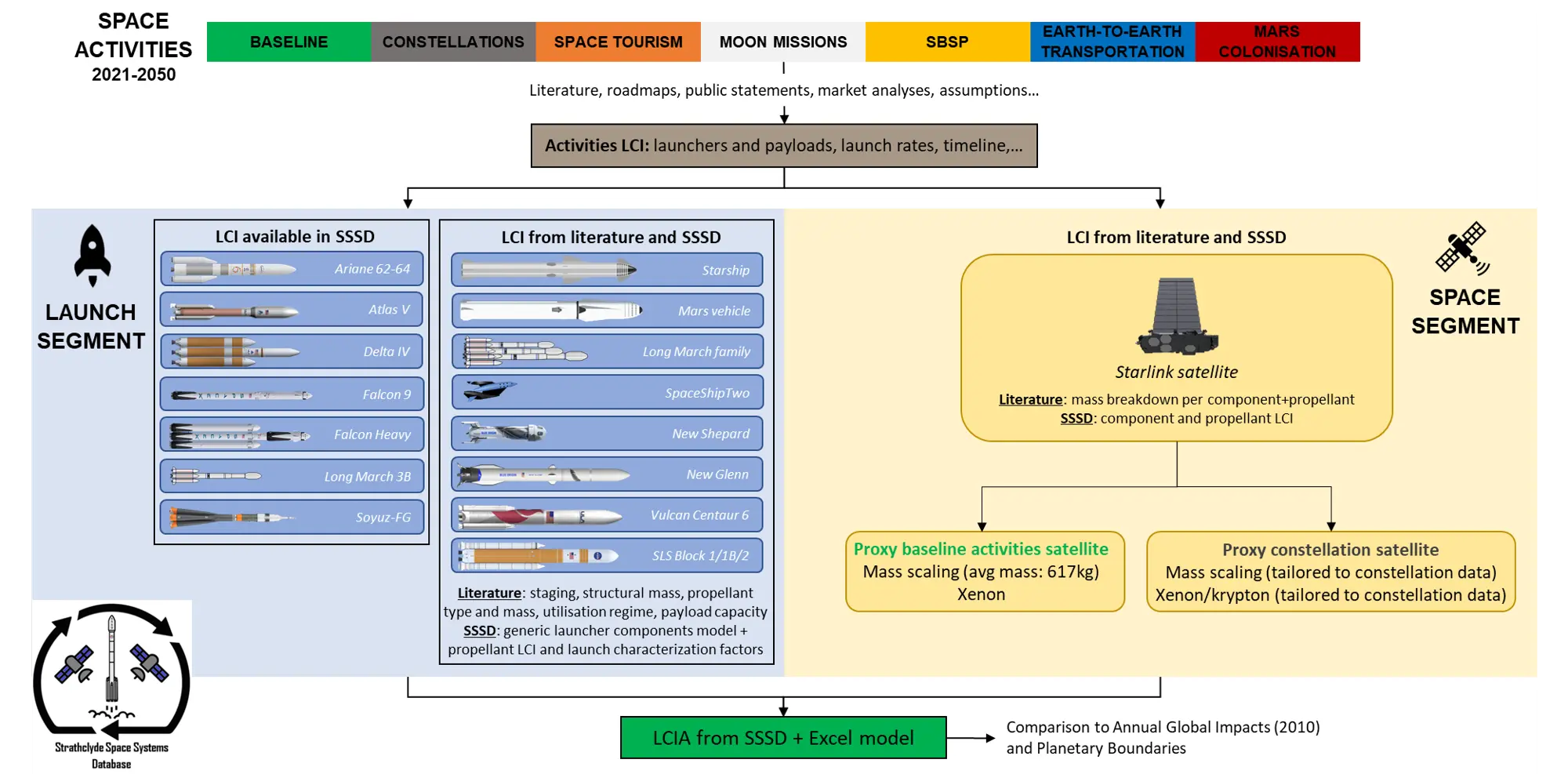
What would be the impact on the Earth’s environment if the projects announced by actors in the space sector came to life? Even the craziest ones?
Why ask this question?
Because despite repeated warnings from scientists on the alarming trajectory of Spaceship Earth and the disastrous consequences for its passengers (human and non-human), the fantasy of inexorable technological development and economic growth is still in control.
While the space industry has historically been an ally in the fight against environmental change through Earth observation programs, it is increasingly at the service of this deleterious model of development. Some icons of the sector feed this fantasy with grandiose narratives and projects of “making humanity a multi-planetary species” (understand colonizing Mars), traveling by rocket from one point to another on Earth in <30mins, or democratizing access to space for tourism.
However, on these projects, as well as on others a little more realistic and already engaged (e.g. large constellations), almost no environmental study has been done.
That’s why I started this study about 1.5y ago. I was joined by Andrew Wilson and Guillermo Joaquín Domínguez Calabuig, who made it possible, and I’m glad to announce that our paper has just been published in Acta Astronautica.
We’ve estimated the environmental impacts of major space projects announced for 2022-2050 using life cycle assessment, without considering their technical and economic feasibility (so it’s like a thought experiment, not a prediction).
Some key results:
- The “realistic” projects would lead to an unprecedented increase in the impacts of space activities, reaching high levels of ozone depletion (6% of global impacts), but low for climate change. However, when proxy high-altitude effects of particles emitted by rockets are included, within 10y they could alter the radiative balance of the atmosphere as much as today’s global aviation.
- Space tourism beats any existing activity in terms of environmental inequalities by combining extreme footprints per passenger and economic inaccessibility (dedicated post to come).
- The impacts of speculative plans for terrestrial rocket transportation and Mars colonization are prohibitive(considerable impacts on the ozone layer, and probably also on the climate because of particles). This has a major implication: escaping the destruction of the Earth’s ecosystems by creating a self-sufficient colony on Mars… destroys the Earth’s ecosystems in the process. In the Anthropocene, far from being a way out, space colonization is a dangerous delusion.
All this is not really ideal (and often not credible) when we urgently need to go back within planetary boundaries while ensuring a good life for all.
These results are, of course, to be verified by future studies, but they already provide fundamental answers that can help to inform policies and question some widespread narratives of our future.