Environmental limits to the space sector's growth
Scientific paper proposing the first review of the sustainability issues related to space activities.
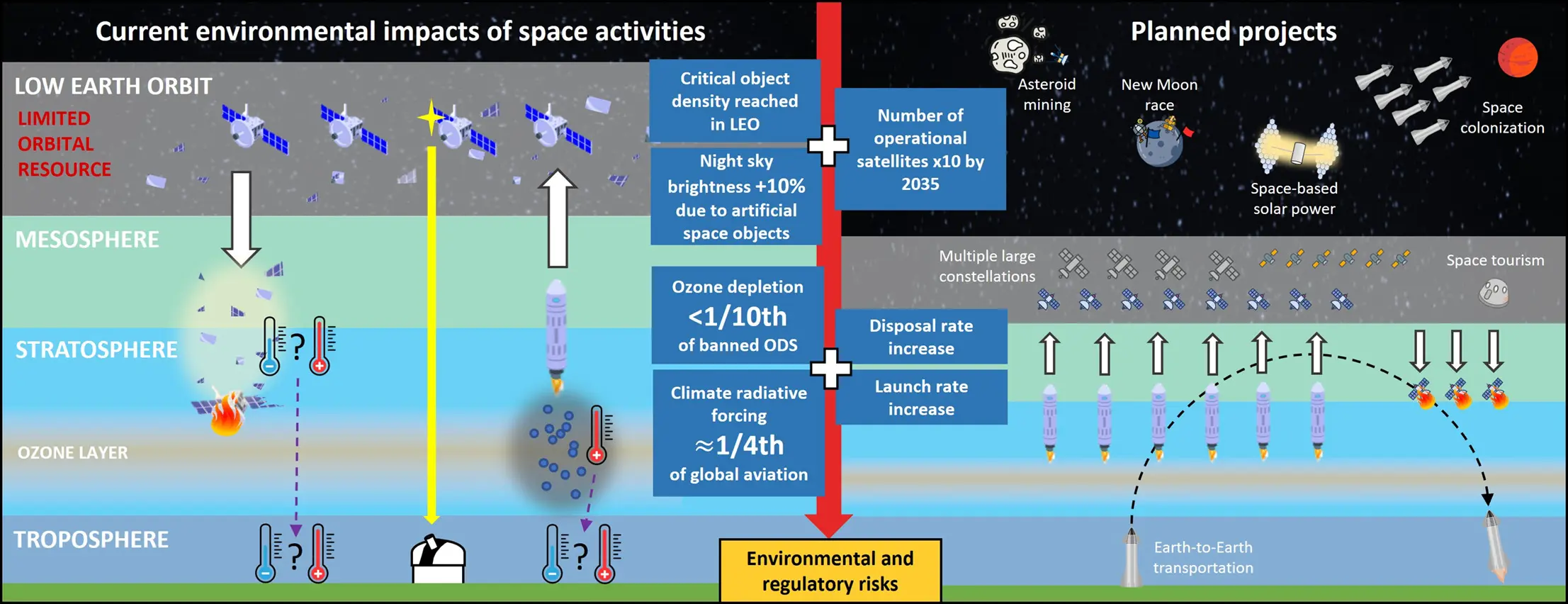
The space sector has entered a new age, with plans of multiple large constellations, space tourism, Earth-to-Earth transportation, space-based solar power, space mining, Moon bases, Mars colonization…
But humanity has also entered a new age: the age in which its activities are transgressing the Earth’s biophysical boundaries. So, what are the current impacts of space activities on the environment? And how could they evolve if proposed plans are implemented?
In a paper published in Science of the Total Environment, I try to address these questions. The current states of space debris, night-sky pollution, ozone depletion, and climate change from space activities are reviewed, and their potential future evolution is discussed. Associated risks are explored, and the importance of ecodesign is emphasized. Then, the relevance and acceptability of planned projects in times of environmental breakdown and global ecological transition are questioned.
It is commonly assumed that the only limits to the human enterprise in space are of a purely technical and economic nature. Yet, the number of objects in orbit is already expected to increase even without additional launches due to self-sustaining debris generation, and the light pollution from artificial space objects could have already crossed the threshold defined by astronomers. This is before the launch of most of the planned large constellations. Atmospheric impacts, while presently small (although considerable for only ~100 launches per year), could reach levels triggering regulatory responses considering the coming surge in launch rates. Therefore, it seems that there are also environmental limits to the current development of space activities.
This raises questions on the desirability of making space “for all humanity” or attempting to “make humanity a multi-planetary species” through intensive colonization, as proposed by some commercial companies. What if shooting for the stars came at an unbearable cost for the Earth’s environment?
Even though much progress still needs to be done to better understand the environmental impacts of the space sector, especially the effects of launcher emissions, this paper calls for a quantitative assessment of the impacts of proposed plans… which is what I am trying to achieve with a great research team!
[QUANTITATIVE ASSESSMENT STUDY NOW ACCESSIBLE HERE]