Space services: resilient infrastructures or a house of cards?
Analysis of the growing fragility of the orbital environment in the face of skyrocketing collision avoidance maneuvers and collision risks.
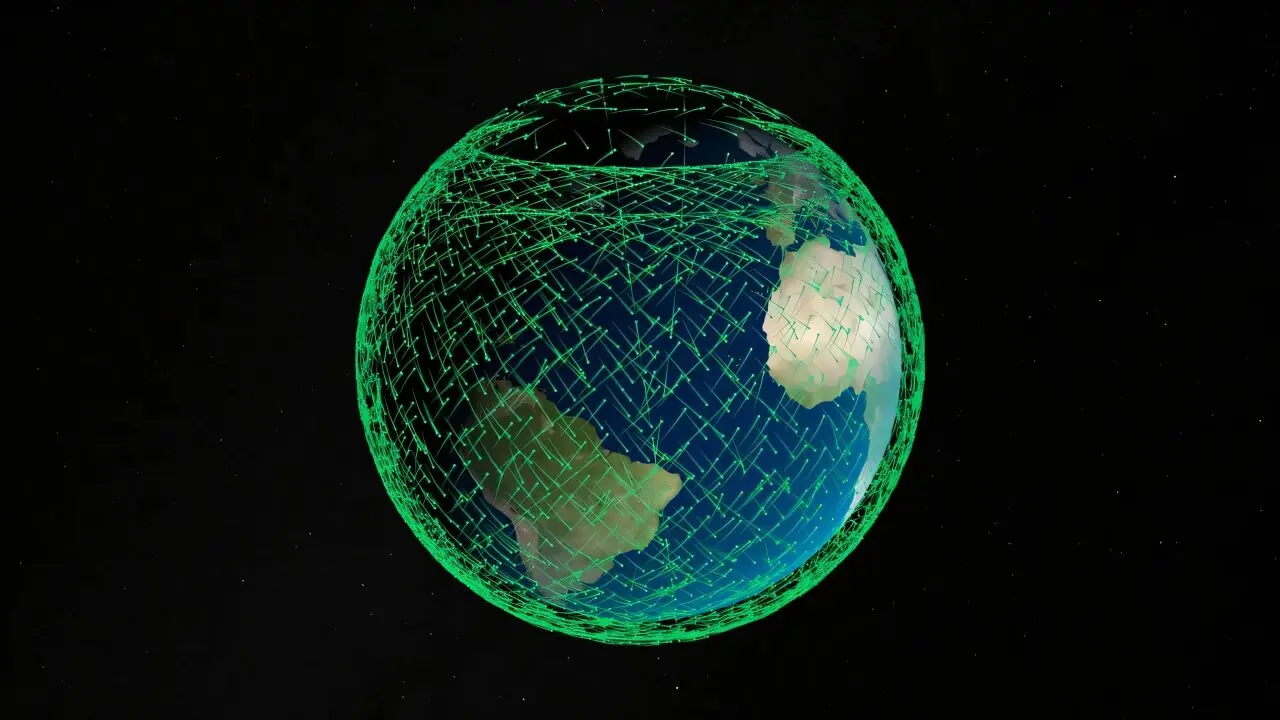
Source : NASA Scientific Visualization Studio
Are the space services on which our societies heavily depend truly resilient, or are they built on a house of cards? Two recent news items illustrate a reality that remains largely underestimated: the growing fragility of the orbital environment.
A catastrophic collision narrowly avoided
A few days ago, due to a lack of prior coordination, a newly launched Chinese satellite passed within 200 meters of a Starlink satellite. This is a tiny distance considering the velocities involved (7.8 km/s) and the potential consequences1: thousands of debris fragments generated in the densest orbital zone (where Starlink is located), creating a major risk of a cascading effect.
Starlink, in fact, performs a number of collision avoidance maneuvers that doubles every 6 months, reaching 144,000 in the first half of 2025. This figure reflects both the size of the constellation (9,000 satellites) and a demanding approach to space safety, not by choice, but by necessity in the face of rising risk2.
In short, the risk and complexity of space operations are exploding. Orbital stability now depends on permanent monitoring and piloting, where the slightest error can be extremely costly—even though we are only at the beginning of mega-constellation deployment.
The CRASH Clock: a new measure of orbital stress
In this context, a recent study titled An Orbital House of Cards3 (preprint) proposes a new metric to quantify the stress on the orbital environment and our dependence on error-free management: the CRASH Clock. It measures the time remaining before a catastrophic collision in the event of a generalized loss of avoidance maneuvers or object tracking systems.
The result: 2.8 days.
In 2018, before Starlink, this value was 121 days.
A vulnerable system
As we have seen, a major collision can occur even under “business as usual” conditions. What happens in the event of a system disruption? During the solar storm of May 2024, thousands of satellites had to maneuver for 3 days due to a sudden increase in atmospheric drag and the potential collisions induced by these maneuvers. However, after a maneuver, uncertainty regarding a satellite’s position can reach several kilometers, making avoidance highly uncertain: we then approach the scenario measured by the CRASH Clock.
Yet, resilience is often presented as an intrinsic property and a key advantage of space infrastructure. This argument is systematically mobilized for future projects: the European IRIS2 constellation, or even orbital data centers and solar power plants.
However, these findings strongly question this assumption, especially with the added risk of orbit becoming a zone of military confrontation.
This is compounded by other structural vulnerabilities of the space industry in the face of growing systemic risks: numerous single points of failure, ultra-specialized supply chains, long lead times, low bargaining power in the event of shortages, difficult substitutions, and high technological inertia.
References
1. Space.com. Spacecraft from Chinese launch nearly slammed into Starlink satellite, SpaceX says. https://www.space.com/space-exploration/satellites/spacecraft-from-chinese-launch-nearly-slammed-into-starlink-satellite-spacex-says (2025).
2. Lewis, H. Starlink manoeuvre update, July 2025. https://www.linkedin.com/pulse/starlink-manoeuvre-update-july-2025-hugh-lewis-utkhe/ (2025).
3. Thiele, S., Heiland, S. R., Boley, A. C. & Lawler, S. M. An Orbital House of Cards: Frequent Megaconstellation Close Conjunctions. Preprint at https://doi.org/10.48550/arXiv.2512.09643 (2025).